
A nineteenth-century essay can seem to change direction every few paragraphs. A discussion of work becomes a discussion of moral responsibility; an observation about society becomes a claim about human nature. Reading every sentence more slowly may help, but it does not always reveal the structure. A short argument map gives the reader another option: record what the author wants accepted, what reasons support it, and which assumptions connect those reasons to the conclusion.
This is particularly useful for historical writing about people, communities and wellbeing. The method below is a reading exercise, illustrated with invented examples. It does not attribute modern biological concepts to a historical author.
Begin with the document, not a quotation
Record the author, title, publication date, publication venue and edition. Distinguish the date an essay first appeared from the date of a later collected volume. Note whether the screen shows a page image, a modern transcription or an excerpt. These are different routes to the text. A transcription makes searching convenient; the page image can resolve a questionable word, a missing paragraph or a footnote placed elsewhere.
The Library of Congress primary-source analysis guides encourage observation, reflection and questions. For an essay, a useful application is to separate what is physically present on the page from what you infer about its purpose. “The paragraph addresses factory owners” is an observation if it names them; “the author wanted their financial support” would need additional evidence.
Write the claim as a complete sentence
A subject is not yet a claim. “Education” identifies a topic; “education should be available outside working hours” expresses a position. After reading a section, write one sentence beginning “The author argues that…” Keep qualifiers such as some, usually, should or under these conditions. Removing them can turn a limited argument into a universal statement that the author never made.
Do not expect every paragraph to contain the final conclusion. Some paragraphs define a word, describe an opponent’s view or prepare an example. Mark their job before adding them to the map. A paragraph that begins with an objection may not express the author’s own belief. Read through the response before extracting a quotation for your notes.
Separate reasons from examples
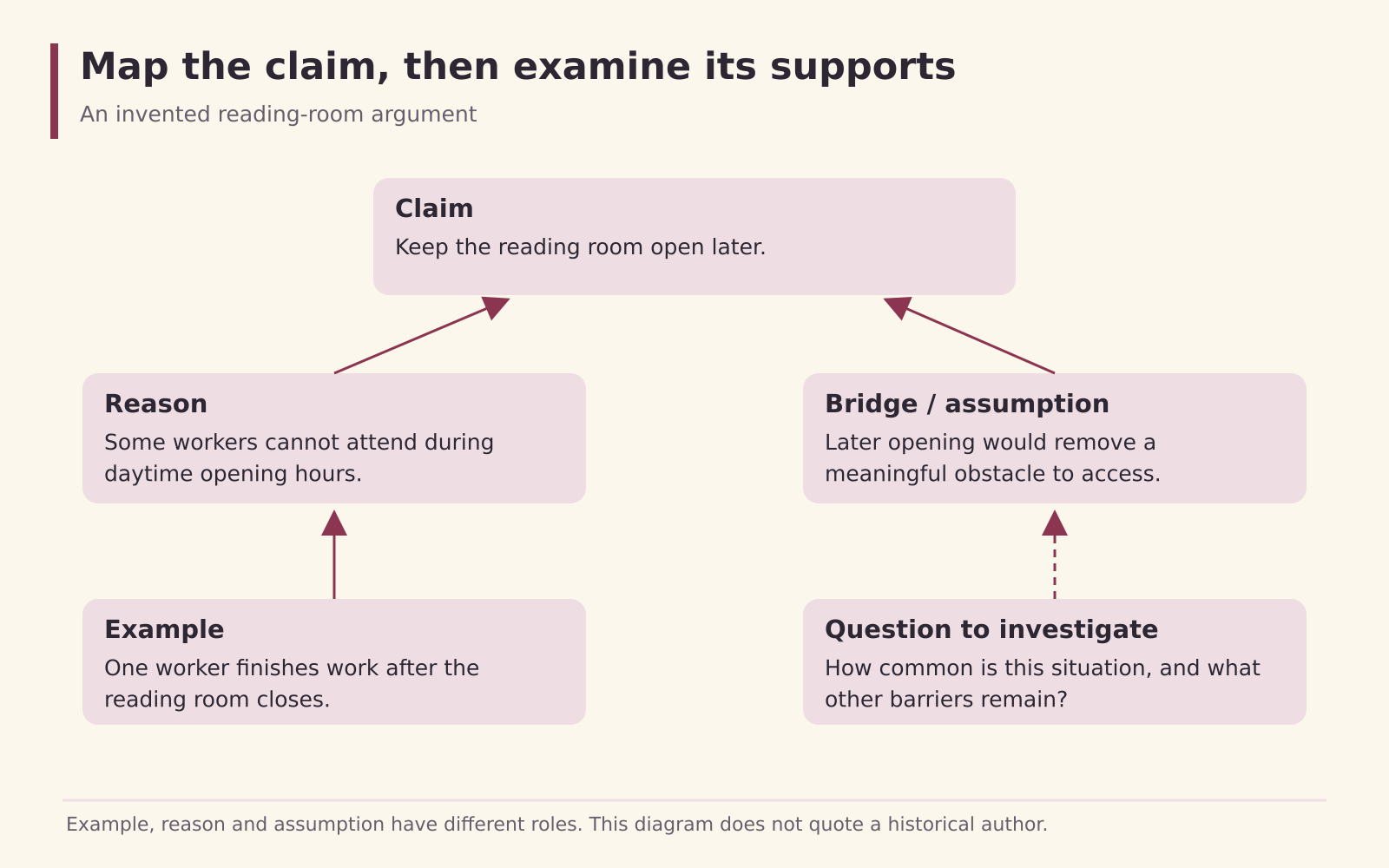
Consider an invented claim: a town should keep its reading room open later. One proposed reason is that workers cannot visit during daytime hours. A story about a particular worker illustrates that reason. The story may make the claim vivid, but one person’s experience does not establish how many people face the same problem. Your map should preserve both pieces without giving them identical evidential weight.
Use three columns: proposed conclusion, supporting reason, and example or observation. If several examples support the same reason, place them together. If the author offers two independent reasons, give each its own row. This prevents an essay with many anecdotes from looking as though it contains many independent demonstrations.
| Element | Invented example | Reader’s question |
|---|---|---|
| Claim | Open the reading room later | For which days and audience? |
| Reason | Daytime access excludes some workers | How is that exclusion established? |
| Example | One worker finishes after closing | Is the example typical? |
| Assumption | Later opening would improve access | Are other obstacles considered? |
Find the bridge between fact and value
Historical essays often move from a description to a recommendation. “These people work long hours” describes a condition. “Their leisure should be protected” adds a judgment about what matters. The second statement may be persuasive, but it does not follow from the first without a value or principle connecting them. Naming that bridge makes the argument easier to discuss fairly.
Write the missing premise as a question rather than silently inserting it as the author’s position. For example: does the argument assume that everyone deserves time for learning? Does it assume that a community should pay for access? An answer may appear elsewhere in the essay. If it does not, leave the assumption marked as your reconstruction.
Read disagreement as part of the record
A published response can reveal what contemporaries thought was at stake. It can also expose a difference between the author’s intended point and the way a passage was received. The Library of Congress discussion of The Lowell Offering and its writers describes a response to Orestes Brownson’s portrayal of factory workers. That exchange provides a concrete reason to read voices on more than one side of a historical argument.
Keep the response on a separate map initially. Ask whether the reply challenges a factual assertion, the description of a group, an implied moral judgment or the proposed remedy. Two writers can share a concern while disagreeing sharply about who is entitled to describe the problem. Combining their positions too quickly hides that disagreement.
Give margin marks a defined meaning
A small annotation system can keep a long essay readable. Use C for a proposed claim, R for a reason and O for an objection, but define the marks at the top of the page. Add a question mark when a passage’s role remains unclear. The notation should record your interpretation rather than make it look final.
After finishing a section, check the marks against the paragraph transitions. If a passage you labelled as the author’s claim is later rejected, revise the label. This simple correction prevents a dramatic sentence from being detached from the argument that qualifies it. Keep page numbers with the notes so another reader can examine the same passage.
Finish with a bounded reading note
A useful note has four parts: the argument as you understand it, the strongest supporting passage, an unresolved question and the location of the text. This is more durable than a page of isolated quotations. It also makes revision possible: if another section changes your interpretation, you can identify exactly which connection in the map needs adjustment.
For a reading group, ask each person to produce a one-sentence claim before debating it. If the claims differ, return to the essay. Disagreement about interpretation should be resolved before disagreement about agreement. The same habit helps when reading modern writing about health or human behaviour: identify the proposition, preserve its limits and distinguish the evidence from the recommendation built on it.
An argument map is therefore a record of reading, not a verdict. Its purpose is to make the author’s reasoning visible enough to examine, challenge and, when justified, revise your own understanding.